
Housing First, Rapid-Rehousing and Transitional
Over the past year, our Supportive Housing mahi, including Transitional Housing, Rapid Rehousing, Outreach and Housing First, has operated in a challenging environment shaped by reduced Emergency Housing availability, increasingly complex whānau needs, and limited growth in government funding.
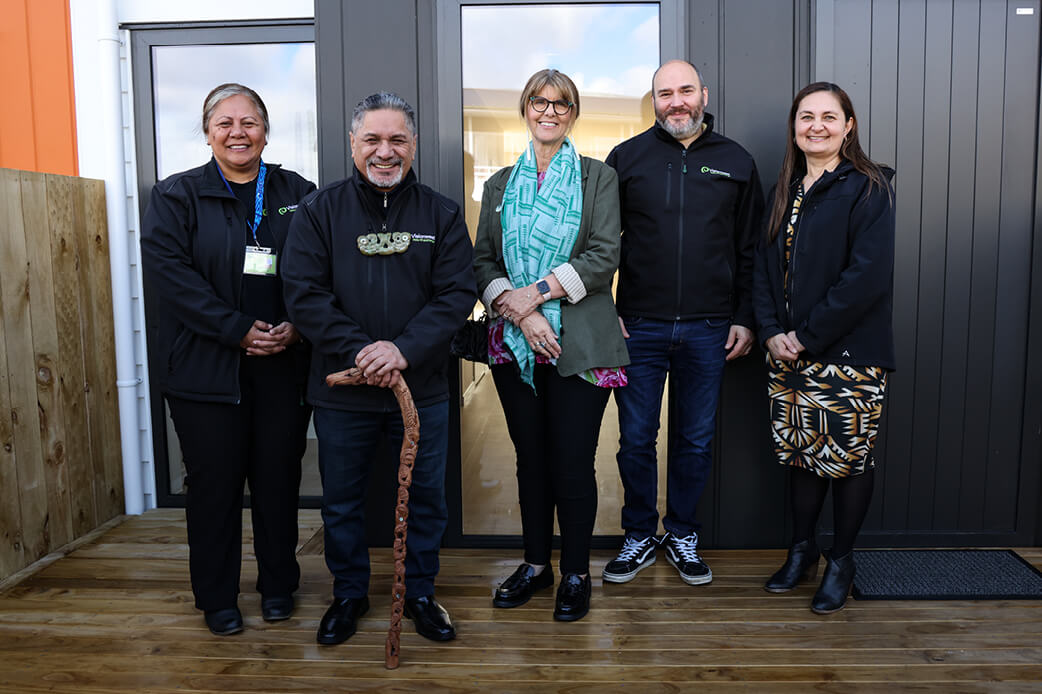
Member of the Executive and Board Chair at Project 500 first homes blessing
Aside from limited additional Auckland FTE linked to the Housing First Priority contract extension, Housing has not received significant new resourcing, even as referrals increasingly involve mental health challenges, drug and alcohol addictions, family harm, financial hardship, disability, neurodiversity, and other complex support needs.
Referrals increasingly involve many complex support needs.
These pressures have placed significant demands on frontline kaimahi, reinforcing the importance of professional development, external supervision, strong line management, and robust systems to support safe, consistent practice.
At the same time, the wider Supportive Housing service has grown. The Government’s flexi-fund has also helped open up additional social housing options, reducing homelessness and creating pathways for whānau waiting for suitable homes. The growth also enabled nine kaimahi working across Housing First Priority, Transitional Housing and Outreach to move into permanent roles, strengthening continuity across the service. New and extended contracts, more kaimahi across services, and stronger internal processes have led to more consistent, best-practice ways of working.
Positive progress has also been seen in Ōtautahi, where stronger housing stock has enabled whānau to move more quickly from Transitional Housing into permanent homes, though this has increased assessment workloads and property turnover for the small local team. In South Auckland, finding suitable homes for larger Māori and Pasefika whānau remains difficult, although Visionwest’s recent social housing purchases will help address this need.
Ongoing challenges include a shortage of appropriate homes for whānau with disabilities, significant physical needs, neurodiversity; language and cultural barriers for former Mangere Refugee Centre residents; and inconsistent engagement where whānau face addiction, violence, stress or changing circumstances. Frontline kaimahi are also reporting greater discrimination towards people sleeping rough and other people experiencing exclusion, alongside increased financial pressure, stress and serious incidents in the community.
Even so, stronger collaboration between Supports and Tenancy teams, alongside partnerships with agencies such as Victim Support and Police Family Harm, is helping create more preventative, wraparound responses that support whānau into safer, more secure homes.
A key development has been the extension of the Housing First Priority contract, increasing capacity by 90 whānau and enabling more people to access housing and wraparound support.
As more whānau moved from Housing First into social housing, capacity was released to support others experiencing homelessness. 225 tenancies were moved from Transitional to Permanent housing during the year, contributing to 662 households permanently housed across Visionwest’s wider housing services. This impact is reflected in the growth of Housing First leased properties from 334 to 499, while Visionwest-owned and managed homes increased from 636 to 879.

TENANCIES WERE MOVED FROM TRANSITIONAL TO PERMANENT HOUSING
Ashton’s Story
Ashton has come through some tough challenges and struggles. “I was sick of it all... I needed a change and a good change.”